
Transport Fever 3 offshore oil and fishing guide: rigs, fishing grounds, ships and climate limits for sea supply chains. Pre-launch.
How Does Transport Fever 3 Offshore Oil and Fishing Work?
Quick answer: Transport Fever 3 adds offshore industries, oil platforms and fishing grounds, as first-class producers that only ships can sensibly serve. Rigs feed fuel and industrial chains while fishing grounds supply towns and canneries, but both are climate-gated: deserts have no fisheries, and subarctic maps push you onto the water far earlier than veterans expect. Exact yields, costs, and platform mechanics are still pending launch verification ahead of the September 29, 2026 release.
Why the sea matters this time
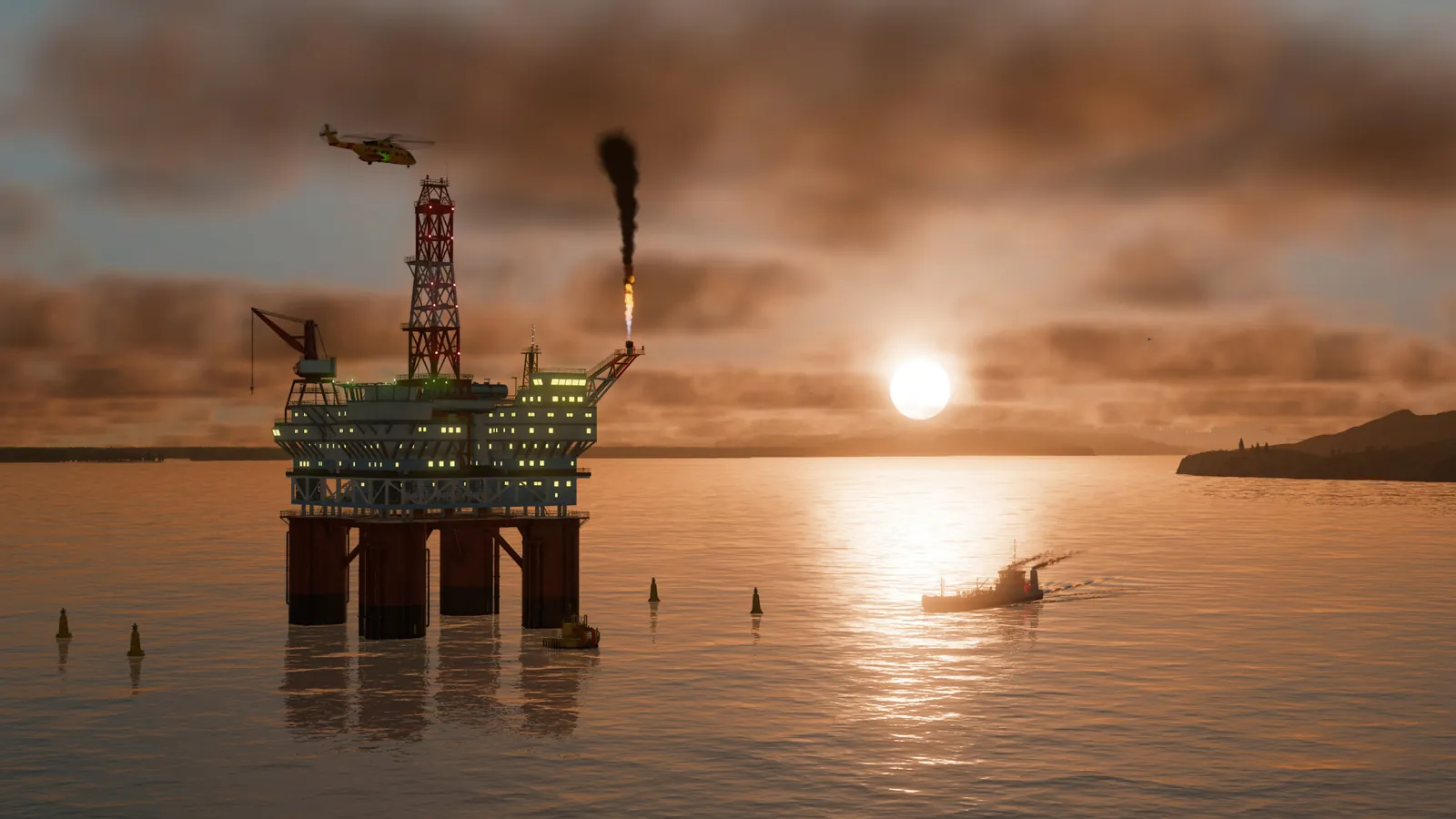
In TF2, ships were the thing you built eventually, when a map happened to have a convenient coastline. TF3 flips that. Offshore sectors, explicitly fishing grounds and oil platforms on the Steam store page, sit out in the water as real producers inside your supply chains, and the press kit states plainly that ships become indispensable for moving their goods ashore. Ignore the sea and entire chains stay locked.
Official source: Transport Fever 3 on Steam
The subarctic climate sharpens the point. Hands-on previews report that subarctic play creates the need to run ships much earlier than in previous games, with tundra, swamps, and scattered islands making overland routes miserable. If your map seed rolls subarctic coastline, budget for a harbor and your first hulls in the opening years, not the opening decades. Newcomers planning that first line should cross-check First Line Setup for Beginners before spending the starting loan on boats.
Oil platforms: fuel for the machine
Offshore oil extends the classic oil chain onto the water. Crude from the rig needs tanker transport ashore to refineries, which then feed fuel into towns and higher industry. The Episode 2 blog shows oil handled as liquid cargo, stored in tanks and barrels and moved in tankers, so every link from rig to refinery wants the liquid specialization: tanker ships, liquid-capable docks, and liquid-tuned storage.
Two practical consequences follow. First, the harbor question is structural, not decorative. Multi-purpose constructions let harbors combine ship piers with extras like helipads, so plan the oil terminal as a combined facility from the start rather than bolting piers onto a fishing dock later. Second, oil is patient cargo. Bulk liquids tolerate slow delivery far better than food, so the cheap slow barge that would ruin a fish run is perfectly respectable for crude. Match speed spending to cargo patience, not to pride.
Official source: Dev Blog Episode 2: Industries and Cargo
Fishing grounds: food with a fuse
Fishing grounds produce the opposite kind of freight: low-volume, high-urgency food. Towns demand fish from the smallest hamlet stage upward, and fish also feeds the canned food chain, where players choose between meat, fish, or a mix for the cannery filling. That dual role makes fishing boats some of the hardest-working small hulls in the early game.
But fish goes stale in game terms. Food carries short delivery deadlines, and late loads damage the destination town's delivery rating even though they still pay cash. A fishing operation therefore lives or dies on the last mile: fast boats, a short hop to shore, and quick onward transport to town or cannery. Everything about the urgency math is laid out in the production chains overview.
| Offshore industry | Produces | Onward chain | Urgency |
|---|---|---|---|
| Oil platform | Crude oil (liquid) | Refinery into fuel, then towns and industry | Low, bulk patience |
| Fishing ground | Fish (food) | Direct town supply, cannery filling | High, short deadline |
| Coastal cannery link | Canned food (goods) | Large town demand | High, finished food |
Fishing grounds pay back with small cheap boats serving nearby towns, which suits a thin starting wallet. Oil needs tankers, refinery links, and harbor works, so treat the first rig as a second-phase investment after basic food and town income stabilize.
Climate gates: no fish in the desert
For the first time, industries adapt to climate zones, and the official example is blunt: there are no fisheries in deserts. The canned food chain demonstrates the fallout, since arid-zone canneries can only use meat while subarctic ones choose between meat and fish. Map seed thus decides strategy before you lay a single sleeper.
Scout the water before committing. Confirm fishing grounds exist within practical sailing range, check which towns will want fish at their next growth tier, and look at the overland alternative, because meat from inland farms competes with every fish you land. The full map of confirmed chains is tracked in the production chains overview, and hull options will be catalogued at Vehicles List once launch numbers are verified.
Preview coverage also notes climate-specific cargo in the new subarctic region generally, with 35 industries and 40 cargo types quoted in the February 2026 hands-on. Against the dev blog's 37 cargo types, that "40" stays flagged as pending launch verification, and offshore players should not plan around cargo that may or may not exist.
Official source: Hands-On Preview: Transport Fever 3
Ships, harbors, and the air alternative
The vehicle roster runs from paddle-steamers to supertankers, and offshore logistics wants both ends: small fast hulls for fish, big liquid hulls for crude. Vehicle stats with noise, pollution, and loading-speed attributes are shown in the overhauled purchase menu with a comparison mode, which should make hull shopping transparent after launch. Until then, no speeds or capacities are confirmed.
Rotors deserve a footnote. Helicopters are a brand-new vehicle class in TF3, and harbors can integrate helipads in multi-purpose builds. Whether light high-value seafood shuttles pencil out against boats is untested, but the option exists on paper. Helicopter coverage lives at Helicopters Guide.
Boats are capital-intensive and slow to reposition. Verify that a town actually demands fish or that a refinery chain is ready for crude before ordering hulls, using the same demand-first discipline as any land route. An idle supertanker is the most expensive decoration in the game.
Frequently Asked Questions
Are offshore industries required or optional?
Effectively required on water-heavy maps. Oil platforms and fishing grounds sit inside real supply chains, and towns that demand fish or fuel need somebody serving them. On landlocked seeds they matter less, but most random maps include usable coastline.
Can trucks or trains serve an oil rig directly?
No sensible way has been confirmed. Offshore producers are built around ship access, with piers and harbor constructions as the interface. Plan every offshore link as water-first with land legs only after the harbor.
Why is there no fishing on my desert map?
By design. Fisheries do not spawn in deserts, and industry availability varies by climate zone. If the map offers no fish, build the meat side of the food chain instead, especially for canneries.
Should fish go by fast boat or helicopter?
Unverified until launch. Boats are the confirmed, economical baseline. Helicopters are new and their cargo economics untested, so treat air seafood shuttles as an experiment for after release, not an opening strategy.
What offshore numbers are still unknown?
Nearly all of them: platform output rates, fishing yields, ship capacities and speeds, harbor costs, and whether rigs accept worker or input boosters. Everything quantitative on this page is pending launch verification from September 29, 2026.
More Transport Fever 3 Guides
Helicopters are new in Transport Fever 3, with the Sikorsky S-76 confirmed. What they are good for, what they cannot do, and costs still unconfirmed.
How money works in Transport Fever 3: delivery income, running costs, full loads, and the route habits that turn thin lines profitable.
Transport Fever 3 landmarks grant area bonuses tied to headquarters and company rank. Confirmed landmarks, how bonuses work, and subsidy details still pending.
Transport Fever 3 loans and contracts explained: dynamic borrowing, risk-versus-reward deals, and rules for debt that builds instead of kills.
Transport Fever 3 mods run through an in-game browser with cross-platform support. Learn Curated Mods, mod.io, and Workshop status.
Cut noise and pollution in Transport Fever 3: barriers, trees, underground rail and fleet maintenance. Pre-launch guide.
Fix Transport Fever 3 lag and stutter: graphics settings that help, CPU bottleneck advice, and late-game slowdown cures that work.
How Transport Fever 3 production chains work: 37 cargo types, boosters, deadlines and the canned food chain. Pre-launch guide.